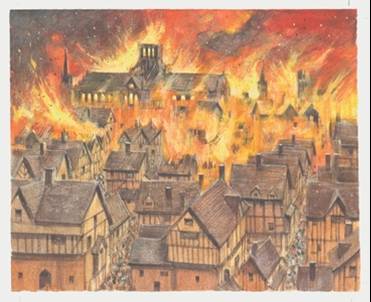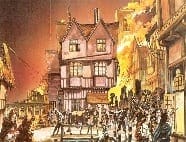
This innovative session places pupils right from the start of the enquiry in the role of detectives to discover when, where and why the Great Fire of London broke out.
Using a wide range of carefully chosen images, pupils have to sift through the evidence to find answers to the key questions, before comparing their findings with a brief expert video.
Learning objectives
- Pupils are able to raise valid questions relevant to the enquiry
- Pupils are able to extract information from sources
- They can combine information
- They learn how to make deductions from maps
Step 1
Set the scene using slides 2-5 of the PowerPoint which give pupils some context of 17th Century London. You might also want to play a version of the short nursery rhyme ‘London’s Burning’ e.g. Example nursery rhyme
to help get a feel for the period, without giving much away.
Pupils are given a brief overview of the fact that the fire burnt down a quarter of London, but they are not told where, when, how or why. That is for them to work out. So, with slide 6 projected, a good place to start would be to ask pupils what questions need answering in our investigation. They usually find this difficult but it is an important dimension to thinking like a historian.
Step 2
With slide 7 projected, explain to the children that they are going to be detectives and work out why the fire began and who might be to blame.
They are given a folder of clues from which they have to work out where, when and why it started. The folder contains eight clues described below on slides 8 to 15. Some are harder than others, so I would suggest you think about different routes through the clues.
Lower-attaining pupils will obviously need more classroom support but they will benefit considerably if you build in a gentle gradient of difficulty so they don’t get dispirited by finding clues that are too hard for them at the start.
Slide 8 Map of London showing area where fire started (dated as 2nd September) and how it spread over next few days. Pupils should be able to work out that the earliest date must ben when it started) (Harder)
Slide 9 From a contemporary newspaper with the date at the top ringed in red. (Medium)
Slide 10 Extract from diary saying that it broke out in a bakers’ shop in Pudding Lane. (Medium)
Slide 11 Map which shows Pudding Lane with blue plaque saying it was where fire started. (Easier)
Slide 12 Shows image of a baker’s oven. Pupils’ attention should be drawn to the sparks flying from the oven. (Medium)
Slide 13 Shows the baker Thomas Farriner. (Easier)
Slide 14 Shows that the start of the fire was Sunday 2 September (Easier)
Slide 15 Shows bundles of twigs used to start the baker’s oven in the mornings. Its important that pupils notice the firewood on the left rather than just the sparks from the oven. (Medium)
This open-ended enquiry is designed to be open-ended allowing you time to support those who need structure whilst giving plenty of scope for the higher-attaining to think more independently.
Step 3
Having come up with their own theory, which you build up on the IWB, pupils can now compare their ideas with the Museum of London video (You Tube).
Show video for just 80 seconds 4.50 to 6.00.
– Did they agree with the video?
– Did the video mention anything they didn’t know?
– Did they know anything the video didn’t mention?